
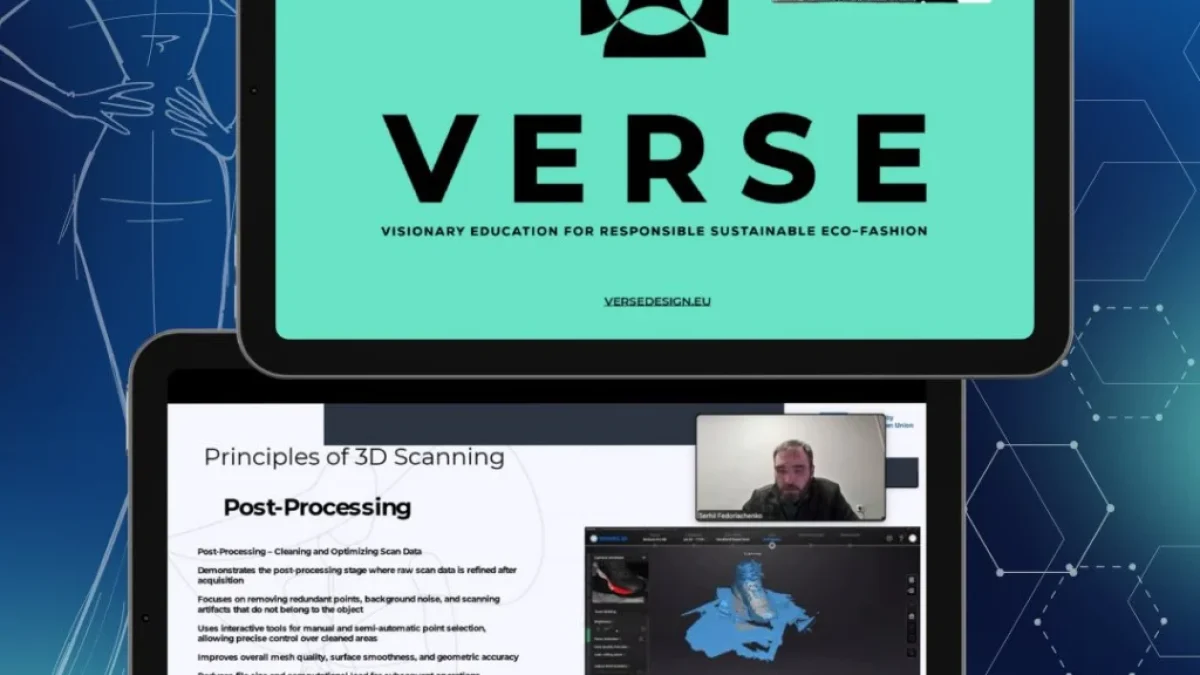
The first VERSE pilot connected learning with a practical challenge: finding new ways to give existing garments a second life. Across its theoretical and collaborative phases, the programme brought fashion, technology, sustainability and business perspectives into the same learning journey.
The final results
Result | Pilot 1 outcome
Challenge completers | 24 learners
Learner country representation | Ukraine: 15 · Portugal: 5 · France: 4
International student teams | 3
Final project proposals | 3
Final evaluators | 8, from 5 countries
Microcredential badges sent | 24, on 3 July 2026
Twenty-four learners completed the Pilot 1 Business Challenge. Working in three international teams, they developed three proposals for garment renewal through 3D printing and presented their ideas at the final pitch session on 21 May 2026.
The final cohort included 15 learners from Ukraine, five from Portugal and four from France. This mix of backgrounds gave students the opportunity to develop their ideas with peers across borders and disciplines.
Eight evaluators from five countries reviewed the projects using six criteria. Their assessment considered how clearly each team communicated its idea, the quality and creativity of the proposal, its feasibility and impact, and the students’ responses during discussion.
Recognising the learning journey
All 24 Challenge completers were sent the VERSE Program Microcredential Badge on 3 July 2026. This recognition followed their completion of the Business Challenge and final project presentation.
The three final proposals explored different routes to longer garment use: personalised printing with digital provenance, renewed surface and structural details, and a second life for wedding dresses. Team 1’s Second-Life Couture was selected as the winning proposal.
What the first cycle brings to the next
The pilot also generated feedback for improving future editions. Partners reviewed the learning sequence, the balance between live sessions and independent activities, and the organisation of the programme calendar. These lessons are informing the preparation of Pilot 2.
Beyond the numbers, the first cycle demonstrates the value of connecting students, educators and an industrial partner around a shared problem. It created a setting in which students could develop an idea together, explain their choices and respond to professional feedback.